
Atoka County Released Inmate Records
Release from Atoka County custody is an event, not one universal document. A county record may be a jail-register row, a bond receipt, a release screen, or a transport log. A court file may hold the order that authorized the person’s departure. For someone leaving Mack Alford or Howard McLeod, the Oklahoma Department of Corrections may hold a status history, discharge entry, parole record, or inactive legal file. The best proof names the person, the facility, a date, and the disposition.
A person can leave one building without becoming free from all custody. Bond, dismissal, time served, sentence completion, parole, probation, transfer, and a detainer handoff have distinct meanings. A detainer is a request by another agency to assume or continue custody. A transfer changes the custodian. Neither should be described as community release. That distinction matters greatly in Atoka County because local jail custody and state prison custody exist side by side.
- Time served
- Custodial time ordered in the matter has been completed or credited.
- Parole
- Conditional release from prison while the sentence remains under supervision.
- Probation
- Court-ordered supervision in the community, sometimes without a prison stay.
- Discharge
- The controlling corrections custody or supervision obligation has ended.
- Detainer
- A hold or request from another agency that can prevent community release.
How Atoka County Releases Occur
The source record should identify what happened after the last confirmed custody. A bond release means the criminal case continues outside jail under stated conditions. A dismissal may remove one basis for confinement, but another case or hold can remain. Time served or sentence complete concerns the custodial term in a particular matter. Parole is a prison release followed by ODOC supervision. A suspended sentence can place a person on probation. Each route leaves a different paper trail.
| Release or exit type | Meaning | Best next record |
|---|---|---|
| Bond or recognizance | Leaves pretrial jail custody while the case continues | Jail release entry and court bond filing |
| Time served or sentence complete | Finishes the custodial term in that matter | Release entry, judgment, and jail credit |
| Dismissal or court order | Judicial or prosecutorial action removes that detention basis | Filed order or dated docket event |
| Parole | Leaves prison under conditions and ODOC supervision | ODOC status and PPB result or certificate |
| Transfer or detainer handoff | Moves into another agency’s custody | Transfer log and receiving-agency record |
Escape, death, and an administrative status change are not ordinary releases. They must not be folded into a recent-release count. If a code or short label is unclear, ask the records custodian for the field definition. Exact language is safer than an inferred meaning.
Fields in Atoka Release Records
A focused Atoka County release-record request should seek the smallest set of fields that can establish identity and disposition. The sheriff may keep the data in a chronological jail register or booking system rather than a document titled “release record.” Ask for a code key when a reason appears as an abbreviation. A bare “out” or “inactive” label has limited value unless it is paired with a date, facility, and explanation.
| Field | What it shows |
|---|---|
| Full name and stable identifier | Helps distinguish people with similar names |
| Booking number and booking time | Ties the release to the correct local custody episode |
| Charge, hold, and case number | Connects the jail entry with the legal matter |
| Release date and time | Records when that facility completed the exit |
| Release type or disposition | Separates bond, completion, court order, parole, and transfer |
| Receiving agency or destination | Shows whether another custodian took control |
| Releasing authority | Identifies the order, court, or agency basis |
| Booking photograph, if kept | May help match the correct booking but does not prove disposition |
No verified Atoka source states how long a booking remains online. Web display and legal retention are separate issues. ODOC policy says state field and legal records move to inactive storage after discharge from custody or supervision. County records follow lawful schedules, but the specific Atoka jail series and period must come from the county custodian.
Request Atoka County Release Records
The Atoka Sheriff’s public domain did not provide a working records form, email address, fee schedule, office hours, or response deadline on the research date. A narrow written request remains the sound local route. Oklahoma’s Open Records Act requires prompt, reasonable access to nonexempt public records during regular business hours. It does not force an office to create a report that it does not keep.
- Verify the current Sheriff’s Office records contact by calling 580-889-2221 before sharing private identifiers or paying a charge.
- Give the full name, booking number or date of birth if lawfully known, approximate custody dates, and any Atoka case number.
- Ask for the jail-register or booking entry, release date and time, disposition, holds, transfer destination, authority, and photograph if kept.
- Request electronic delivery and a fee estimate before costs are incurred. Ask for the legal basis if any field is withheld.
- If staff say the record was destroyed, ask for the record-series name, retention schedule, and disposition date.
Under 51 O.S. §§ 24A.5 and 24A.8, standard copy fees generally may not exceed twenty-five cents per page or one dollar per certified page. Search fees apply only in stated circumstances and must follow a posted schedule. No Atoka-specific charge was verified, so request a written estimate.
Atoka Release Orders in OSCN
Atoka District Court cases can outlast a short jail display. The OSCN district-court search lets a reader select Atoka County and search by case number or party. The event chronology may show an appearance bond, bond reduction, dismissal, judgment and sentence, jail credit, commitment, revocation, warrant recall, or later modification. Read the entry in context. A bond filing does not prove the jail completed release at that exact moment.
Repeated access can trigger a Turnstile human-verification screen. That challenge is not evidence that the case is absent. Use a normal browser, then obtain the filed order from the Atoka County Court Clerk when an abbreviated entry does not settle the question. A city-only matter may be held outside the county district-court system and should not be forced into an OSCN match.
The access interruption is visible in this captured view of the OSCN search portal.
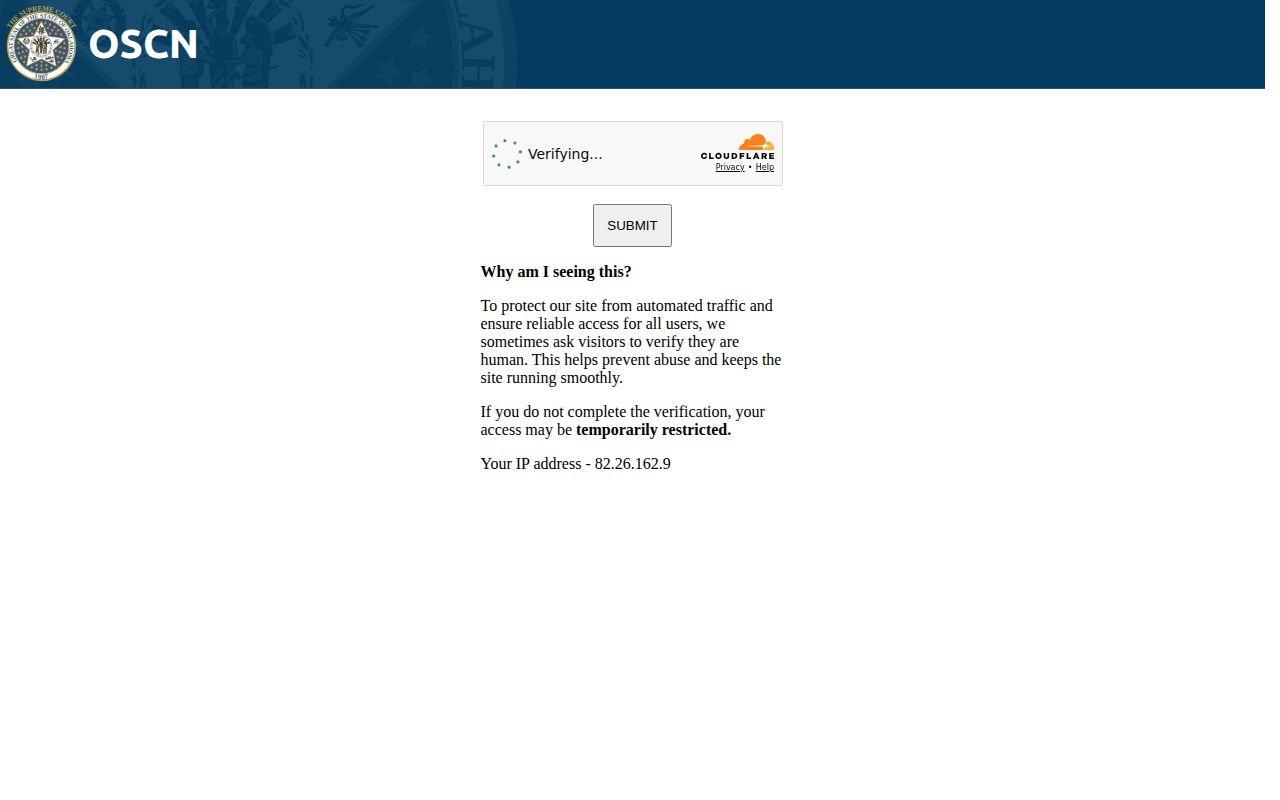
Once verification is complete, the county selector, party fields, and case search lead to the chronology, while the clerk’s filed copy remains the stronger source for exact terms.
Atoka Release Records After Expungement
Oklahoma expungement is a court-sealing process. It is not a guarantee that every lawful historical copy vanishes. Eligibility depends on the categories in 22 O.S. § 18, and OSBI does not pre-approve eligibility. A qualifying petition is filed in the district court where the arrest information is located, with notice to the prosecutor, arresting agency, OSBI, and other named agencies under § 19.
OSBI listed a $150 agency processing fee on the research date and warned that local charges may also apply. Current amounts should be checked before filing. The official process and its limits are summarized on the OSBI expungement page.
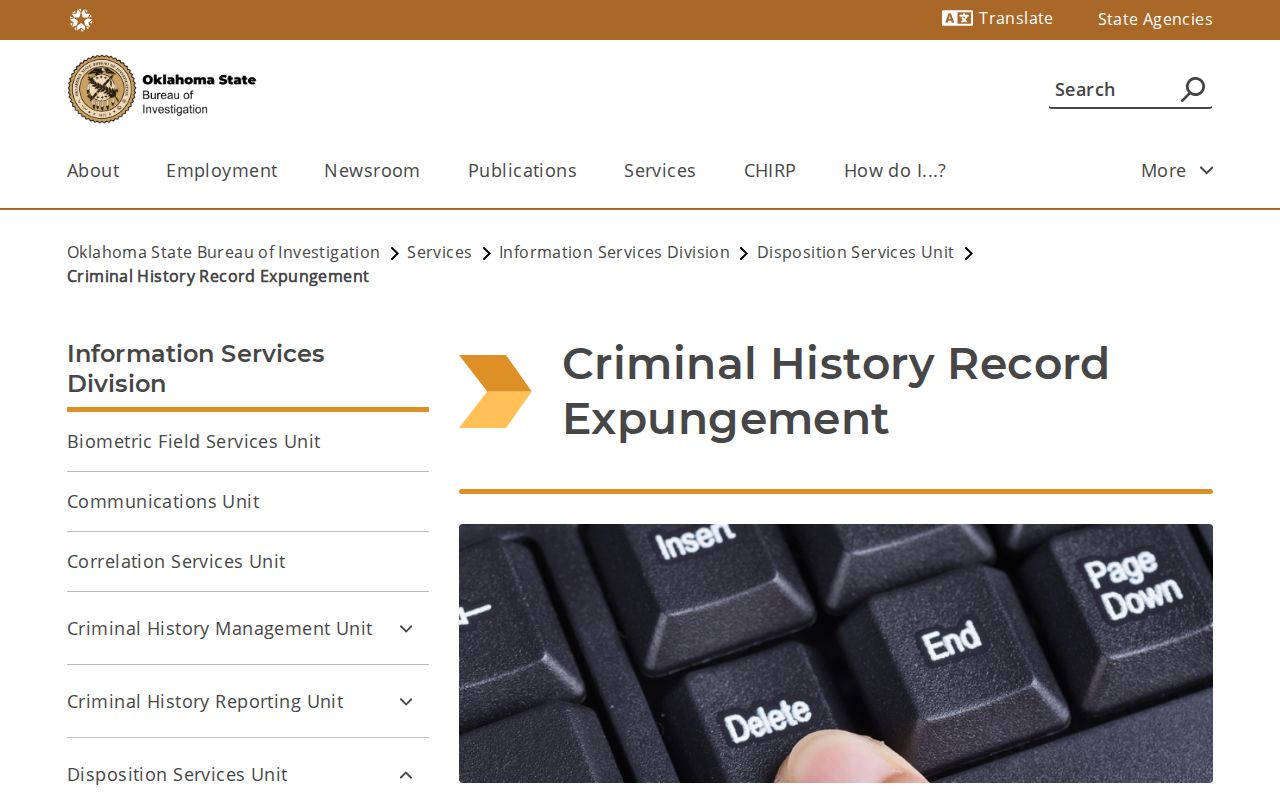
The page is the current agency starting point, but the order and Title 22 statutes control the result. A blank public search after sealing does not prove that no historical custody or release occurred.
Find Atoka County Released Inmates
Start with the last certain custodian. Atoka County Jail, Mack Alford Correctional Center, Howard McLeod Correctional Center, BOP, and ICE each use different records. A live jail roster, if one returns, answers who is in local custody now. It is not a historical release index. The search should move from the system that owned the custody to the court and notification records that explain the event.
- Write down the person’s full name, known identifier, last facility, and the date that custody was last confirmed.
- For Atoka County Jail, call the verified sheriff contact and ask for the release disposition or receiving agency.
- For an Oklahoma prison, search ODOC by DOC number when known, or match the exact name and date of birth.
- Search the Atoka court chronology for the order, judgment, bond, dismissal, commitment, or warrant event.
- Check OK VINE for the specific person and reporting agency, then confirm the event with the source record.
- Use BOP for federal prison custody or ICE ODLS for current immigration detention when those systems are plausible.
- Request the underlying release or transfer record when a database result is absent, unclear, or inconsistent.
Match at least two identifiers when possible. Date of birth, DOC or booking number, middle name, case number, and facility date reduce false matches. Do not merge two people based on a common name or a similar photograph.
Why did the name leave the roster? It may mean release, transfer, a system gap, or a moved record. Absence alone cannot identify which outcome occurred.
Atoka County Release Feed Gap
No functioning official Atoka County Sheriff roster, recent-release archive, 24-hour list, 72-hour list, or agency-linked inmate app was verified on July 31, 2026. The apparent public sheriff domain displayed a registrar “coming soon” page. Claims from unrelated commercial directories about daily updates, long archives, exports, or filters are not proof that Atoka offers those features.
The research-date condition is visible in this capture of the Atoka Sheriff domain.

That web gap makes the written jail-register request, OSCN chronology, VINE event, and receiving-agency search more important. It does not mean the Sheriff keeps no record.
For a time-window request, state Central Time and exact endpoints. Ask for entries whose release timestamp, not booking timestamp, falls within the period. The Released Last 24 Hours page explains how to define a short Atoka release interval without inventing an online feed.
ODOC Atoka Released Inmate Search
The OK Offender Lookup is the correct state starting point for someone who left Mack Alford, Howard McLeod, or another ODOC institution. It can also cover a person retained in ODOC’s custody or supervision universe. It is not the Atoka jail release list. The direct system begins with a notice and may require a normal browser to complete CAPTCHA.
| Search field | Use | Caution |
|---|---|---|
| DOC number | Most direct identifier when known | Confirm it belongs to the correct person |
| First and last name | Basic person search | Common names can return several people |
| Date of birth | Narrows a name match | Compare with another identifier |
| Alias option | Includes listed alternate names | Broader results raise false-match risk |
| Similar-sounding option | Helps with spelling variation | Do not treat a loose match as identity |
Record the exact status, location or supervision label, date, and DOC number. Parole is not discharge. “Inactive” should not be translated without the system’s definition. ODOC warns that public data are abbreviated and may not fully explain the offense, sentence, or time to serve. Its Offender Information gateway also describes a particular release date as tentative and subject to limits on routine public disclosure.
Note: A projected date can change, while an actual status or discharge event confirms that a release step occurred.
Why Atoka Release Searches Split
Atoka County contains a small county custody system and two state prisons. This is why the phrase “Atoka inmate” is unusually ambiguous. A local arrestee may be held by the Sheriff. A person convicted in another Oklahoma county may be serving an ODOC sentence at Mack Alford or Howard McLeod. The operator, not the nearby town name, determines the right release record.
Mack Alford began as an Oklahoma State Penitentiary sub-prison in the 1930s. The institution later had wartime and youth-facility uses. Howard McLeod was built in 1962 by prisoners from the nearby Stringtown institution, and ODOC reports dinosaur finds on its grounds. Those histories are more than local color. They explain why a state lookup can be necessary even when a facility has an Atoka County address.
The state facility record may describe parole, discharge, detainer release, or movement within ODOC. A move between prisons remains a transfer. A person leaving either prison may return to a community elsewhere in Oklahoma, and local supervision is based on assignment rather than the prison’s county.
Atoka Release Alerts and Supervision
OK VINE supports person-specific custody status checks and notifications by web, phone, and offered mobile channels. Its event categories can include transfer, escape, apprehension, release, and death. Read the exact event and reporting agency. A VINE release alert is a useful lead, but it is not a certified release record and may not explain the release type.
Statewide availability does not prove that every Atoka booking supplies each event. No county-by-county contributor list was found. Confirm a match with the Sheriff, ODOC, or court. For someone leaving prison on parole, ODOC supervises the person while the Oklahoma Pardon and Parole Board handles parole consideration and results. The Atoka Probation and Parole office serves Atoka and Coal counties, but an individual may be assigned elsewhere based on residence and the supervision plan.
Parole and probation remain different. A parolee has left prison subject to conditions. A probationer is under a court sentence in the community and may not have served prison time. The Parole / Probation page gives the local verification chain when an ODOC or court record shows supervision.
Federal Atoka Release Record Search
The BOP Inmate Locator covers federal prison records, generally for people released after 1982. Search by federal register number when known, or by name with the narrowing fields. A past release date with no institution location can indicate release on that date. A location of “RELEASED” means the person is no longer in BOP custody. It does not rule out supervision or custody held by another government.
BOP explains its record coverage on the locator-records page, shown in this source capture.
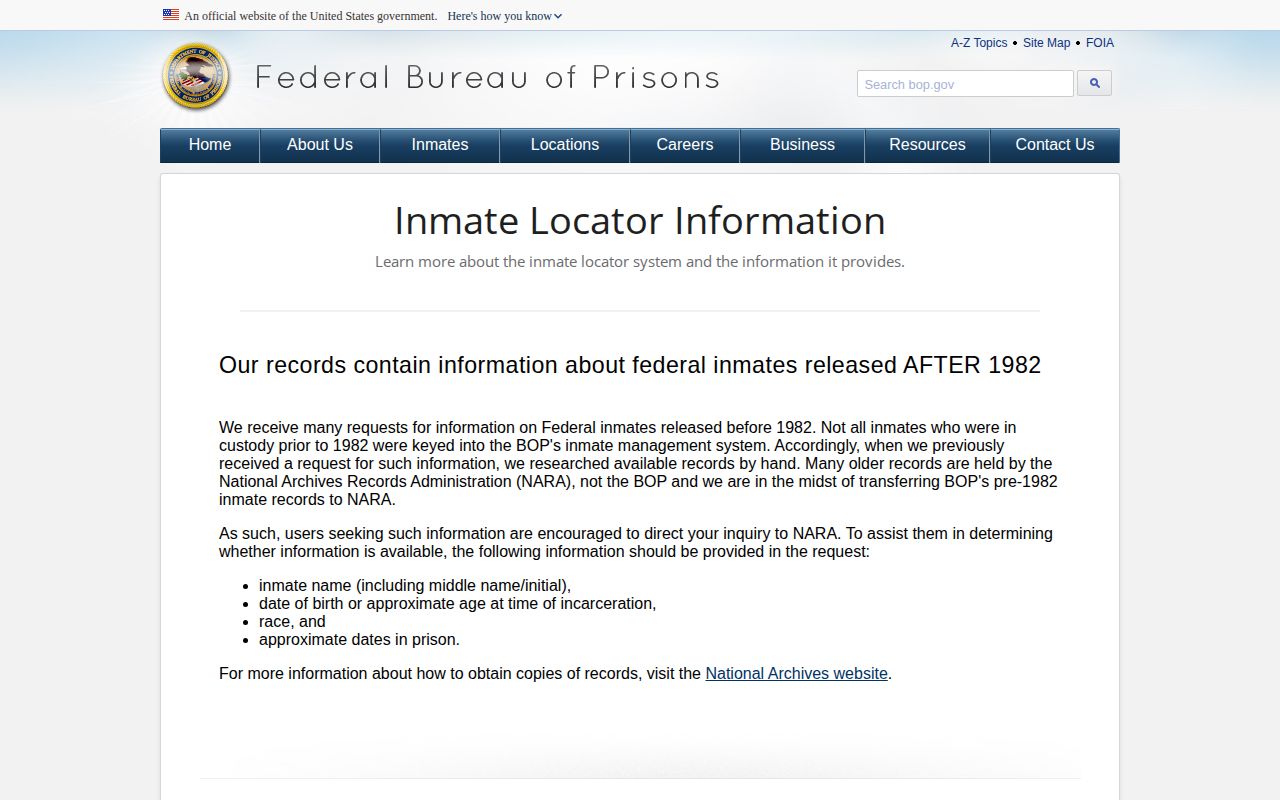
The captured page confirms the post-1982 coverage. The source also distinguishes a projected future date from a completed release. “IN TRANSIT” is not proof of release, and “UNKNOWN” means the term is not determined.
ICE’s online locator is mainly for current immigration detention. A blank result can reflect spelling, identifier, transfer, removal, release, age, or data limits. If the Sheriff reports a handoff on an ICE detainer, describe it as release from county custody to ICE custody. Research found no official evidence of an ICE detention site or standing detention contract in Atoka County.
ATOKA Alerts Are Not Releases
Both state prisons share the Orange Alert keyword “ATOKA.” Under Oklahoma law, that alert concerns an escape or walkaway, not parole, discharge, or a lawful county release. The same keyword for two separate institutions can confuse a person who sees an Atoka alert without reading the facility and event.
Use the ODOC Orange Alert page only for its stated safety purpose. Do not place an escape or walkaway on a released-inmate list. For a lawful departure, use the ODOC status, PPB result when applicable, court record, and VINE notification. These sources identify distinct events and should not be collapsed into one label.
Where Atoka Release Records Appear
The correct system depends on both custody type and time. A current roster answers a present-custody question. A release register or status history answers a past event. Court records can supply the legal basis, while a locator is limited to the agency that operates it.
| System | Best use | What it cannot prove alone |
|---|---|---|
| Atoka Sheriff record | Local booking, release, or transfer disposition | State prison discharge or federal release |
| OSCN and Court Clerk | Bond, order, judgment, dismissal, or commitment | Exact jail-door processing time |
| ODOC lookup | State custody, parole, supervision, and retained history | A local bond-out with no ODOC involvement |
| OK VINE | Participating source status and event notification | Certified disposition or complete archive |
| BOP locator | Federal prison custody and historical release | County, state, tribal, or immigration status |
| ICE ODLS | Qualifying current immigration detention | Historical release from Atoka County Jail |
When sources conflict, preserve the search date and exact labels. Then request the record from the agency that owns the disputed data. A copied entry cannot authoritatively correct the sheriff, court, ODOC, BOP, or ICE source.
Atoka County Release Facilities
Three facilities define the local search map. Start with the one that last held the person, then follow any named receiving agency. The county jail handles local custody. The two correctional centers are ODOC prisons, not branches of the Sheriff’s jail.
- Atoka County Jail: local bond, court-order, time-served, dismissal, transfer, and detainer records belong with the Sheriff and Atoka court sources.
- Mack Alford Correctional Center: state prison departures may be parole, discharge, detainer handoff, or transfer within ODOC.
- Howard McLeod Correctional Center: minimum security does not make every departure a community release; use statewide ODOC evidence.
For either state prison, pair the ODOC status with a PPB result when parole applies and with the court sentence when the legal basis matters. For the county jail, ask the records custodian for the disposition and receiving agency. That final field separates a true local release from continued custody elsewhere.