
Atoka 72-Hour Release Records
No official rolling 72-hour release screen was verified for the Atoka County Jail. The Sheriff’s public-facing domain showed only a coming-soon page during the July 31, 2026 sweep. It exposed no date filter, release archive, field list, update schedule, photo view, or retention rule. That dated observation should be stated narrowly. It does not establish that an internal chronological jail register is absent, nor does it show that a public tool never existed.
The practical substitute is a request for existing jail-register entries with release timestamps inside a defined 72-hour period. A three-day span is useful when the search begins after a weekend or when a record may have been finalized after the physical exit. It should not be treated as three copies of a calendar-day report. The requester must define the boundaries and time zone so staff can identify the correct source rows.
Define Atoka’s Release Window
Start and end times matter. “The last three days” could mean three calendar dates, the prior 72 hours from the moment of the request, or an agency reporting cycle. State the interval in Central Time. If the aim is a weekend, list the first date and time through the final date and time. Ask for rows whose release time, not booking time, falls inside that span.
- Verify the current Atoka County Sheriff records contact through the office before sending personal details.
- Describe the exact 72-hour start and end timestamps in Central Time.
- Ask for existing chronological jail-register or release-log entries within that interval, if kept.
- Request the booking identifier, release time, disposition, transfer destination, detainer, and releasing authority fields that exist.
- Ask when the data were finalized, request a code key, and obtain a fee estimate before staff incur charges.
Use a narrow request. The whole investigative file is rarely needed to answer who left county custody during the window. Under 51 O.S. § 24A.8, specified law-enforcement and jail-register information is available if kept, subject to lawful limits and redaction. The statute does not require the Sheriff to create a special 72-hour feed or to answer questions in place of producing an existing record.
Readers who only need the most recent same-day interval can use the Atoka releases from the last 24 hours. The three-day request is better when time has already passed or a multi-day comparison is needed.
Read Atoka Release Fields
Atoka County has not published a verified online field inventory. The table describes what to request from the actual jail record, not what an unseen web feed supposedly displays. A complete row is more useful than a bare name. It should tie one booking episode to the recorded exit and explain whether another custodian took control.
| Field to request | How to read it |
|---|---|
| Name and booking number | Matches the event to one person and one county booking. |
| Booking date and time | Shows when custody began, not when it ended. |
| Release date and time | Places the recorded exit inside or outside the 72-hour interval. |
| Release disposition | May identify bond, time served, court order, dismissal, or another basis. |
| Transfer or receiving agency | Shows continued custody when the person was moved elsewhere. |
| Case or releasing authority | Points to the order or docket event that supports the change. |
A bond release does not decide the pending case. A time-served entry resolves only the ordered custody tied to that matter. “Transfer” is not release to the community. A detainer is a request or legal basis for another agency to take or hold the person. Where codes are unclear, ask the custodian to provide the field definition rather than guess from initials.
Note: The Sheriff has published no online cadence, so the response date and the source record’s finalization time should be preserved.
Atoka Weekend Release Checks
A three-day window is most useful when ordinary work schedules and jail operations do not line up. A court may authorize release before staff finish bond checks, property return, paperwork, or a hold review. A data row can then be entered or corrected later. Holidays can also make it harder to reach the records custodian or obtain the filed order. None of those conditions supports inventing a standard delay for Atoka County, since no official local cadence was published.
Compare the final hour of one day with the first hour of the next. That boundary check can catch a release posted just outside a calendar-day request while keeping the full three-day period precise.
Use the OSCN Atoka County docket search to locate the legal event. Appearance bonds, bond changes, release orders, dismissals, judgments, jail credit, commitments, and warrants may explain the custody move. The docket text can be brief, and repeated access may prompt human verification. If exact terms matter, request the filed order from the Atoka County Court Clerk rather than infer them from a short entry.
Oklahoma VINE can provide a source-agency custody notification. It is useful for timing but is not a three-day archive and does not always explain the reason for the event. If the county row identifies an ODOC commitment or transfer, search the Oklahoma offender lookup. Atoka County includes two state prisons, yet their records are statewide ODOC records and should never be merged with the county release list.
Atoka’s Missing Release Feed
The key Atoka roster quirk is observable web absence. The Sheriff domain did not show any official release functions during the research sweep. This means no truthful claim can be made about a rolling window, photo availability, an export tool, or how long released rows remain online. Unofficial pages that promise daily updates or long archives have no verified authority to speak for the Sheriff.
If the domain changes, inspect the live tool before relying on it. Confirm the agency operator, exact label, date rule, last-updated marker, row fields, and whether a name opens historical detail. A “current inmates” view is not a released-person archive. Likewise, an empty result could be caused by a spelling issue, a broken site, a purge from the display, or transfer to another system.
Online display duration and legal retention are separate. No statewide period for every county release or booking record was verified. Under 19 O.S. § 517.1, county departments may follow lawful retention and disposition practices. Ask for the adopted schedule and the exact record series if staff report that older rows are no longer held.
Retain Atoka Release Evidence
A three-day reconstruction may be repeated after the live window has passed. Preserve the request, the exact interval, the response date, and any definitions supplied by the custodian. If a row is later corrected, the access timestamp helps explain why two copies differ. Never describe a missing web row as destruction of the county source record.
The Oklahoma State Archives records-management guidance shown below explains the role of records schedules for state agencies. County questions still go to the Atoka custodian.
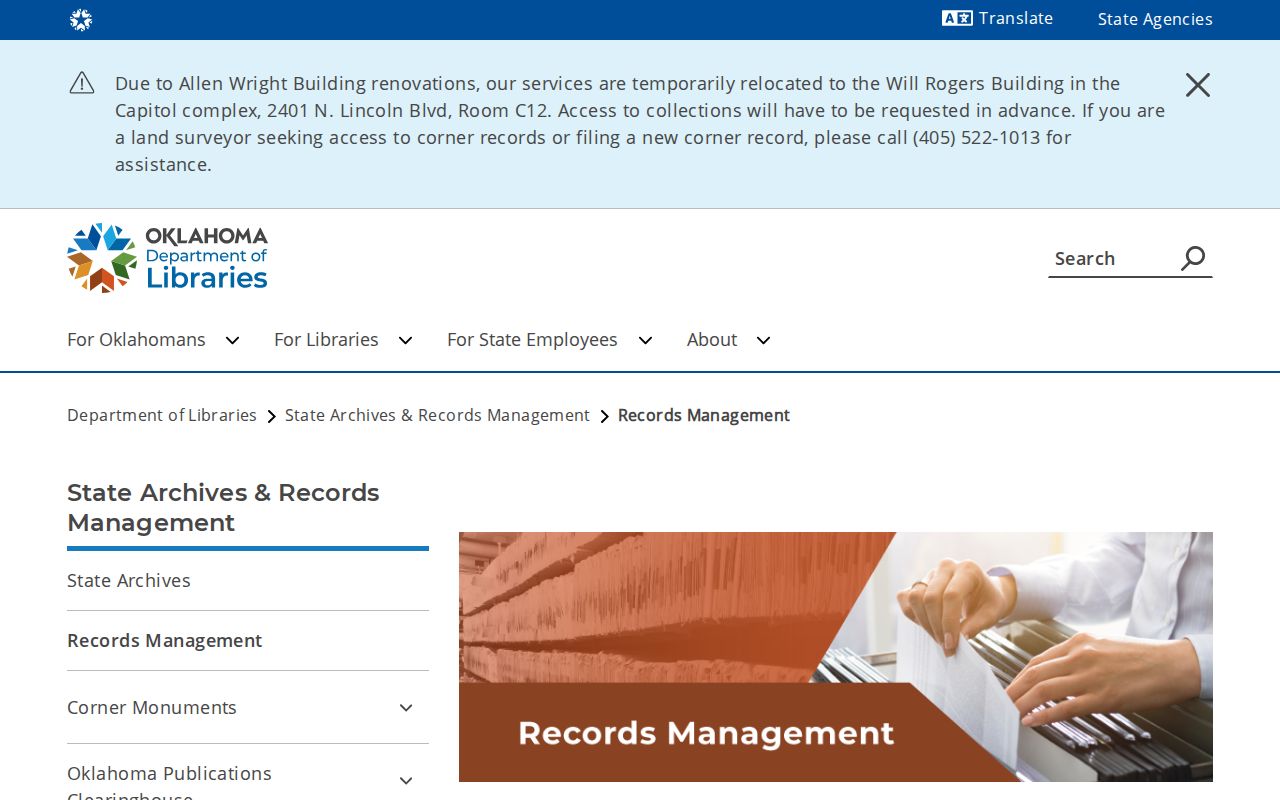
The captured page supports asking for a schedule rather than assuming that a short web display controls how long the underlying release record exists.
When the release reason matters, use two sources. The jail register should establish the county event. The court order, VINE record, or ODOC status can explain its basis and later custody. For a named-person search that crosses systems, follow the Atoka County released-inmate lookup rather than stretching a three-day list beyond its purpose.
Separate Atoka Release and Transfer
Departure from Atoka County Jail can lead to the community, ODOC, another county, tribal or federal custody, immigration custody, a medical facility, or another institution. The destination field is therefore central. An actual community release may follow bond, dismissal, time served, or another court-authorized basis. A transfer ends the local jail stay but continues confinement.
| Record result | What to do next |
|---|---|
| Release with bond or court authority | Confirm the order and check whether any other case or hold applies. |
| Transfer to ODOC | Use the statewide offender record and read the exact status and location. |
| VINE custody-change alert | Confirm the event with the reporting jail or corrections source. |
| Name absent from current roster | Request the final disposition; do not call absence a release. |
Oklahoma’s county jail oversight page discusses inspection standards that include admission and release procedures. The captured official page gives process context.
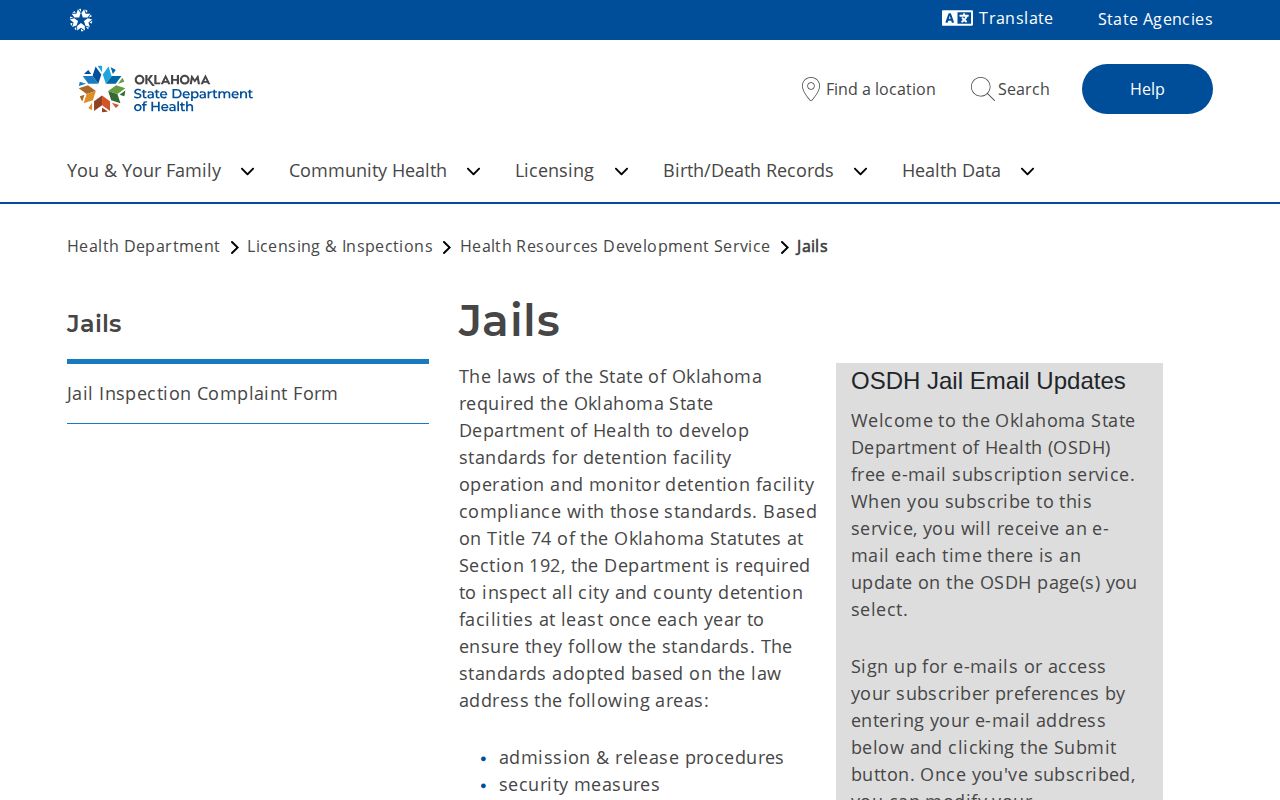
Oversight material is not a named-person release index. It supports the need for a facility record while leaving each Atoka County release to be proved by its own entry.
Note: A 72-hour list records county exits during a period; it does not by itself establish freedom from every other custodial authority.