
Mack Alford Release Paths
Mack Alford Correctional Center is operated by the Oklahoma Department of Corrections. It holds sentenced state prisoners, including men in medium long-term and minimum-security units. Its records are statewide. A controlling sentence can come from Atoka County or any other Oklahoma county, so location alone does not identify the sentencing court or the supervision office after release.
A departure can be parole to supervised release, completion and discharge, transfer inside ODOC, release to another detainer, or another authorized status change. ODOC sentence-administration policy records distinctions that include discharge, parole, sentence modification, added jail time, new sentences or probation, detainers, and release to ICE. Absence from Mack Alford is not enough to choose among them.
| Displayed outcome | Meaning to confirm | Primary record |
|---|---|---|
| Transfer | State custody continues at another institution | ODOC status and location history |
| Parole | Prison custody ends, conditional supervision begins | ODOC status and PPB result or certificate |
| Discharge | Controlling ODOC duty has ended, subject to other cases | ODOC discharge or status record |
| Detainer release | Another authority may take custody | ODOC destination and receiving-agency record |
| Projected date | A tentative future calculation, not a completed exit | Current ODOC calculation and later actual status |
Search Mack Alford Release Status
Use OK Offender Lookup as the first search. Accept the system notice and search by DOC number when known. The verified basic fields include first name, last name, and date of birth, plus options for aliases and similar-sounding names. A common name can return the wrong person, so match several identifiers and record the search date.
Read the exact status, location or supervision wording, dates, and DOC number. Do not translate “parole” into “discharged.” Parole means the person has left prison under conditions and ODOC supervision. Discharge generally means the controlling state custody or supervision duty has ended, though another jurisdiction can still hold the person. “Inactive” also needs the system’s own definition.
- Search the DOC number first, or use the full name and date of birth with care.
- Confirm the matched record belonged to a person at Mack Alford and note the displayed location history.
- Capture the exact status, date labels, DOC number, and access date.
- If parole appears, check the correct PPB docket and validated result.
- Compare the controlling court judgment and any later sentence order.
- Request a focused ODOC status or discharge record when the public result does not resolve the event.
The Atoka County released inmate search distinguishes Mack Alford records from Sheriff, federal, and immigration systems.
Mack Alford Records and Contact
The 2025 ODOC fact sheet provides Mack Alford’s official address and main contact. Call the institution for current procedural routing, not for promises of protected sentence details. For a release record, identify the full name, DOC number, institution, and approximate event date, then ask ODOC for the releasable status or discharge information.
13001 North Highway 69
Stringtown, OK 74525
580-346-7301
Oklahoma Department of Corrections
ODOC’s offender-information page separately lists 580-346-7073 in an inmate-calling table. Research did not establish that number as the main records or facility line, so it should not replace the fact-sheet contact. Office hours and a facility-specific public records email were not verified. Ask for the current ODOC records route and any applicable limits.
The public lookup should be used first. If a needed discharge or status field is absent, a narrow ODOC request is more useful than a broad request for the entire legal or institutional file. Protected medical, security, victim, and unrelated case material may be withheld or redacted.
Note: Verify the main facility contact before relying on any separately listed inmate-calling number for records requests.
Mack Alford Prison Profile
Mack Alford is a state prison with both medium long-term and minimum-security male units. The 2025 Mack Alford fact sheet describes more than 500 men in the medium unit and approximately 260 in minimum security. These figures are time-sensitive, so they show the reported scale rather than a live count.
Unit placement does not determine release. A person can move from one unit to another or transfer to another ODOC facility while remaining in custody. The statewide offender record, not an institution headcount, answers current status. Counts should never be used to infer that a particular person was present or released on a certain date.
ODOC fact sheets also describe educational, cognitive, recovery, parenting, and life-skills programming. Those programs provide transition context but do not calculate an individual release date. Sentence administration, credits, court orders, parole action, and detainers control the legal timeline.
Mack Alford Release Evidence Chain
A parole case requires more than one source. The Oklahoma Pardon and Parole Board publishes monthly dockets and results. A docket shows planned consideration. The matching validated result shows Board action. Some favorable results are recommendations that require Governor approval. Even a final favorable outcome is not proof of same-day physical release.
After Board action, administrative preparation, an approved plan, another sentence, or a detainer may affect departure. Use the ODOC status and parole certificate or order to identify actual parole release and conditions. Supervision then follows the assigned residence and case plan. The fact that Mack Alford is in Atoka County does not mean the Atoka probation office will supervise every parolee.
OK VINE can add notice of release, transfer, or another custody change. Its data depend on the source agency and may lag. ODOC Victim Services lists 405-425-2607 and victim.services@doc.ok.gov for release concerns and direct notification guidance. The sentencing court record supplies the judgment and later orders. Together, ODOC, PPB, court, and VINE show different parts of the same timeline.
Note: Label the Board decision, physical release, and supervision discharge as separate Mack Alford events.
Mack Alford History and Releases
Mack Alford’s local history helps explain why an “Atoka inmate” search can lead to a statewide record. The institution began in the 1930s as a sub-prison of the Oklahoma State Penitentiary. It later served as a World War II foreign-prisoner camp and as Stringtown Boys School before its present ODOC role.
This institutional history is not merely local color. It marks Mack Alford as a state corrections site rather than an Atoka County jail. The prisoners held there can have sentences from across Oklahoma. Their release, transfer, parole, and discharge records belong to ODOC and the controlling courts, not to the Atoka Sheriff roster.
Howard McLeod Correctional Center adds a second state prison to the same county. It was built in 1962 by prisoners from the nearby Stringtown institution. A searcher should therefore start with the exact facility and operator. The Howard McLeod release record uses the same statewide system but a separate institution history and contact.
Mack Alford Orange Alert Meaning
ODOC’s Orange Alert assigns the keyword ATOKA to both Mack Alford and Howard McLeod. The alert concerns escapes and walkaways under 57 O.S. § 701. It is not a parole list, discharge feed, or notice of an authorized Mack Alford release.
An escape is an unauthorized departure and must never be treated as community release. Lawful release evidence comes from ODOC status, PPB action where relevant, the court sentence, and VINE or direct notification. If an Orange Alert names a person, use the official alert and later apprehension information without converting it into a release record.
The successful manifest capture comes from the official ODOC Orange Alert page.
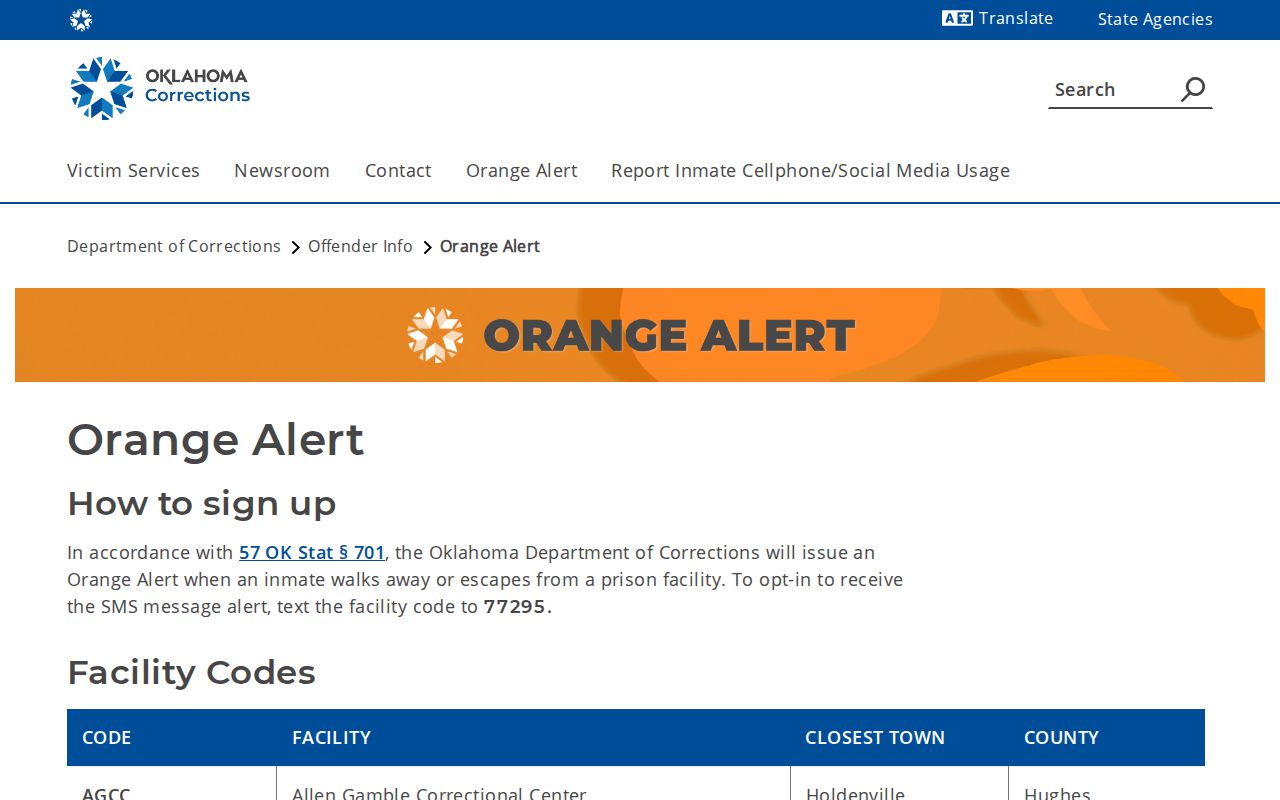
The capture shows the shared local keyword, while ODOC offender and release records remain the correct lawful-release sources.
Mack Alford Detainers and Discharge
A detainer can change where a person goes at the end of an ODOC term. Release from Mack Alford to another county, federal, tribal, or immigration authority ends confinement at this institution but may continue custody elsewhere. Ask the ODOC record for the destination and receiving agency, then follow that system’s own locator.
Projected release dates require similar care. ODOC recognizes a projected-release field, but the public FAQ describes an individual date as tentative and limits routine disclosure. Earned credit, misconduct, achievement credit, sentence correction, parole action, and detainers can change the estimate. Only a past status or discharge event confirms the completed ODOC exit.
Discharge also differs from parole. Parole is prison release subject to conditions and supervision. Discharge generally means the controlling ODOC custody or supervision obligation has ended, though an unrelated case can remain. Preserve the exact ODOC label rather than replacing it with a broader phrase such as “free” or “out.”
When a result is unclear, build a dated sequence instead of choosing one label. Record the last confirmed Mack Alford custody date, the later ODOC location or status, any PPB action, and the receiving agency. A complete sequence can show that institutional custody ended without falsely claiming that all custody or supervision ended at the same time.
Note: Keep institutional departure, receiving custody, parole start, and final discharge as separate dated events.