
Atoka Projected and Actual Release
A projected release date estimates when a sentence calculation may reach its release point under the facts then in the record. It can change. An actual release record shows that a facility completed a release or discharge event. These dates solve different questions. Yesterday’s estimate does not prove that someone walked out today, and a parole eligibility date does not prove the Board acted or that the person was physically released.
Pretrial detention is different. A person held at Atoka County Jail before final judgment does not have an ODOC sentence-based projected date. Release may depend on posting bond, a bond change, dismissal, a court order, or the resolution of another hold. Even when OSCN shows a legal order, jail staff must complete processing and check detainers. The Sheriff’s completed release record supplies the actual time and disposition if maintained.
A sentenced state prisoner at Mack Alford or Howard McLeod is in ODOC custody, not county jail custody. ODOC administers the sentence, while the court judgment remains the source of the sentence imposed and jail-time credit ordered. A movement between the two Atoka County prisons is a transfer. It is not community release.
- Projected release date
- A current estimate based on sentence administration and credits.
- Parole eligibility
- The point when a person may be considered for parole under the controlling law, not a release promise.
- Actual release
- The completed departure event recorded by the custodian.
- Detainer
- A request or hold from another authority that can prevent release to the community.
Find Atoka Inmate Release Dates
Start with the last certain custodian. Use the official OK Offender Lookup for a state prisoner or person within ODOC’s custody and supervision system. The verified basic search uses DOC number, first name, last name, and date of birth, with alias and similar-sounding-name options. A DOC number is the best key when known. Record the search date because status and calculations can change.
ODOC’s public gateway warns that offender information is abbreviated and may not be complete. Research also found that ODOC treats a specific person’s release date as tentative and limits routine public disclosure absent a legitimate need. Do not promise that every public result displays a projected date. If the lawful live result shows one, preserve its exact label and all qualifiers. If it does not, use the court judgment, appropriate ODOC record channel, and permitted contact route.
- Identify Atoka County Jail, Mack Alford, Howard McLeod, or another custodian as the last known location.
- Match a state prisoner in OK Offender Lookup by DOC number or several reliable identifiers.
- For a county case, search OSCN and obtain the filed judgment or release authority from the Court Clerk.
- Separate sentence length, jail credit, parole eligibility, a projected date, and actual release into distinct entries.
- Check for a detainer, another sentence, transfer, or supervision that changes what “release” means.
- Confirm a completed departure with the custodian’s release, status, or discharge record.
For Atoka County Jail, call the Sheriff’s Office at 580-889-2221 after verifying the current office identity and request the named booking’s release entry. Ask for release time, type or disposition, booking number, releasing authority, transfer destination, and detainer notation if kept. No Atoka-specific public roster or date calculator was verified.
The broader Atoka County released inmate search helps route a named person when the last custodian is uncertain.
Atoka ODOC Release Date Access
ODOC’s forms inventory uses the exact label “Projected Release Date.” That establishes the agency term but does not prove open access to a completed form for every person. The ODOC Offender Information gateway describes a particular release date as tentative. It says the value can change with earned-credit level, misconduct, and achievement credits, and that inmates receive a monthly days-remaining figure that they may share or use in their own calculation.
The release date is treated as confidential without a legitimate need in the public FAQ. Judicial and law-enforcement needs are examples in that source. A public lookup may still provide a status or other useful fields, but no request should assume access to private calculation details. Ask narrowly for the releasable status or discharge record and cite the DOC number, full name, facility, and approximate date.
The official form inventory is visible in the manifest image. Review the ODOC Section 06 forms page for the current “Projected Release Date” label.
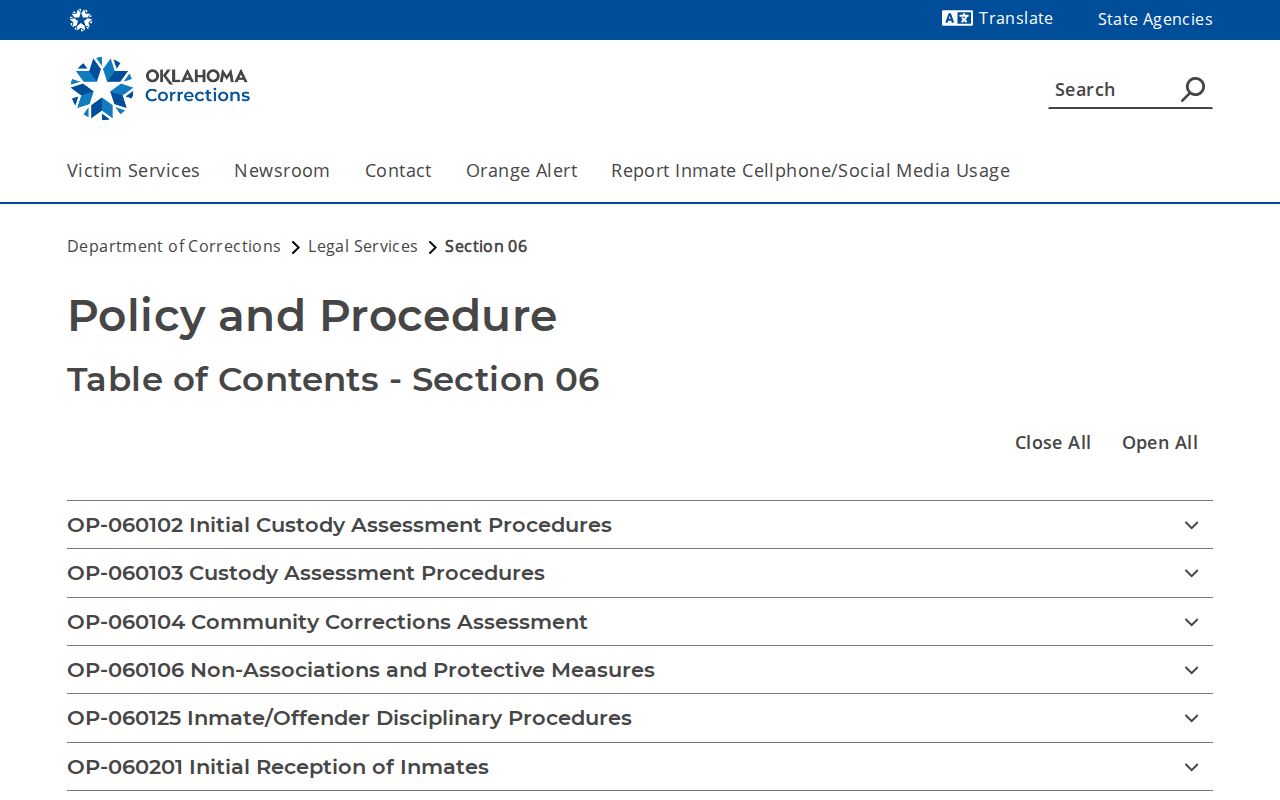
The image supports ODOC’s terminology. It does not turn a tentative calculation into public proof of actual release.
Note: If a projected date is not public, do not infer it from sentence length without the controlling credits and legal events.
Atoka Release Date Credit Rules
The safe calculation is conceptual: start with the controlling sentence, subtract legally credited jail days, apply valid earned and achievement credits, account for concurrent or consecutive sentence structure, and add later amendments, discipline, or restoration. Then check any minimum-service rule. Parole eligibility is a separate point. Detainers and another consecutive case can block release to the community even when one sentence reaches zero.
Current 57 O.S. § 138 supplies Oklahoma’s earned-credit framework. One earned credit equals one day of incarceration. Monthly rates vary by assigned class and statutory category. In the current compilation, a person ever convicted or adjudicated for a subsection E felony has class rates of 0, 22, 33, or 44 credits per month. A person without that history has rates of 0, 22, 45, or 60. Those figures cannot be applied without knowing the correct category and class.
The statute separately addresses achievement credits, exclusions, disciplinary loss after due process, restoration, life sentences, and monthly tallying. An old rate or one person’s credit history cannot be copied to another case. ODOC’s sentence-credit memo explains that sentence discharge occurs when calculated days remaining reach zero and that the sentencing judge controls pre-sentence county-jail credit through the judgment. Because that memo predates later amendments, use it for process and cross-check the rates against current law.
County jail terms need a separate record. The Atoka judge’s order and authorized jail credit govern the term, while the Sheriff performs release processing and checks other holds. Research verified no Atoka-specific local good-time policy and no weekend or holiday early-release rule. Practices from another Oklahoma county must not be imported.
Atoka 85 Percent Release Rule
Oklahoma’s 85 percent rule appears in 21 O.S. § 13.1. It applies to an enumerated list of offenses. A covered person must serve at least 85 percent of the term of imprisonment before parole consideration, and credits cannot reduce imprisonment below that threshold. It does not apply to all people in ODOC custody.
Do not label every offense commonly described as violent as an 85 percent case. The exact conviction subsection, offense date, amendments, and sentence control. A percentage also answers only a minimum-service or eligibility question. It does not include Board action, Governor approval where required, an approved release plan, a detainer, or final processing.
Parole eligibility under 57 O.S. § 332.7 is also tied to offense and date. The research describes multiple matrices for crimes before 1998, a one-third framework for many crimes from 1998 through 2018, and a one-fourth framework for many crimes on or after 2018. Important exclusions and separate rules apply to life without parole, listed violent offenses, and Section 13.1 offenses. A fraction is not a release date.
When parole is plausible, read the monthly PPB docket and then its validated result. A docket shows planned consideration. Even a favorable final result does not prove that physical release occurred. Use ODOC status, the parole certificate or order, VINE, and the actual release record to finish the timeline.
Why Atoka Release Dates Change
A projected date reflects current inputs. ODOC can recalculate the date when a lawful input changes. Some factors move the sentence calculation itself. Others do not change the sentence end but delay community release. The record should say which kind of event occurred.
| Factor | Possible effect | Record to check |
|---|---|---|
| Class reassignment | Changes the monthly earned-credit rate | ODOC sentence calculation |
| Achievement credit | Adds credit when authorized | ODOC credit history |
| Misconduct | May cause credit loss after due process | Disciplinary and credit record |
| Credit restoration | Can return eligible lost credits | Updated ODOC calculation |
| Corrected jail credit | Changes credited time before or after reception | Judgment and sentence record |
| Sentence amendment | May change length or sentence structure | Filed court order |
| New or consecutive sentence | Can extend the controlling custody term | Court and ODOC records |
| Detainer or hold | May route the person to another custodian | Status and receiving-agency record |
| Parole action | Changes the route to conditional release | PPB result and parole order |
Concurrent sentences generally run together as legally ordered. Consecutive sentences run in sequence. A corrected interpretation can therefore move a projected date even when no new conviction occurs. A vacated sentence or amended judgment can also alter the controlling calculation. Always retrieve the filed order instead of relying on a docket label alone.
A detainer can cause the most common misunderstanding. Reaching the end of one ODOC sentence may lead to transfer to another county, federal, tribal, or immigration authority. The ODOC exit is real, but it is not release to the community. The destination or receiving agency should be recorded.
Atoka Release Countdown Limits
Atoka’s assigned projected-date angle is the gap between ODOC’s named form and the public limits on an individual calculation. The state recognizes a “Projected Release Date,” yet the public FAQ calls the date tentative and restricts routine disclosure. A useful lookup therefore does not promise a live countdown. It identifies the lawful sources and the facts that can move the estimate.
Credits, discipline, achievement, sentence corrections, and detainers can all change timing. Each comes from a different record. The inmate’s monthly days-remaining statement may help the person understand the calculation, but an outside estimate built from an old sentence and generic credit rate may be wrong. Only ODOC can apply the full current record for a state prisoner.
The same caution applies at Atoka County Jail. Research found no local calculator, special good-time rule, or set weekend-release policy. A court date is not a jail-door time. Obtain the judgment, ask how credited days were applied, and request the completed release entry. This county-specific limit keeps unsupported practices from other jails out of the Atoka record.
Confirm Atoka Release Date Records
For a county detainee, compare the Atoka court order with the Sheriff’s final release entry. For a state prisoner, compare OK Offender Lookup with the ODOC status or discharge record and any PPB action. When a person leaves prison on parole, physical release and supervision discharge are separate dates. The Atoka Probation and Parole office should be contacted only when a matched record indicates local assignment.
OK VINE can provide a timely custody-change alert. Registration and its event limits are detailed on the Atoka County VINELink Release Check. The alert still needs confirmation because delivery can lag and a transfer event is not community release. Federal custody belongs in the BOP locator, which can display a past release date and RELEASED location. Immigration detention belongs in ICE’s current locator. Neither belongs in an ODOC date calculation.
A strong final timeline names each event: sentence imposed, jail credit, eligibility, Board action, projected release, physical release or transfer, and supervision discharge. It also names the source beside each date. This method answers what is actually known and avoids treating one estimate as proof of every later stage.
Note: Save the access date and exact source label whenever a projected or actual release date is recorded.